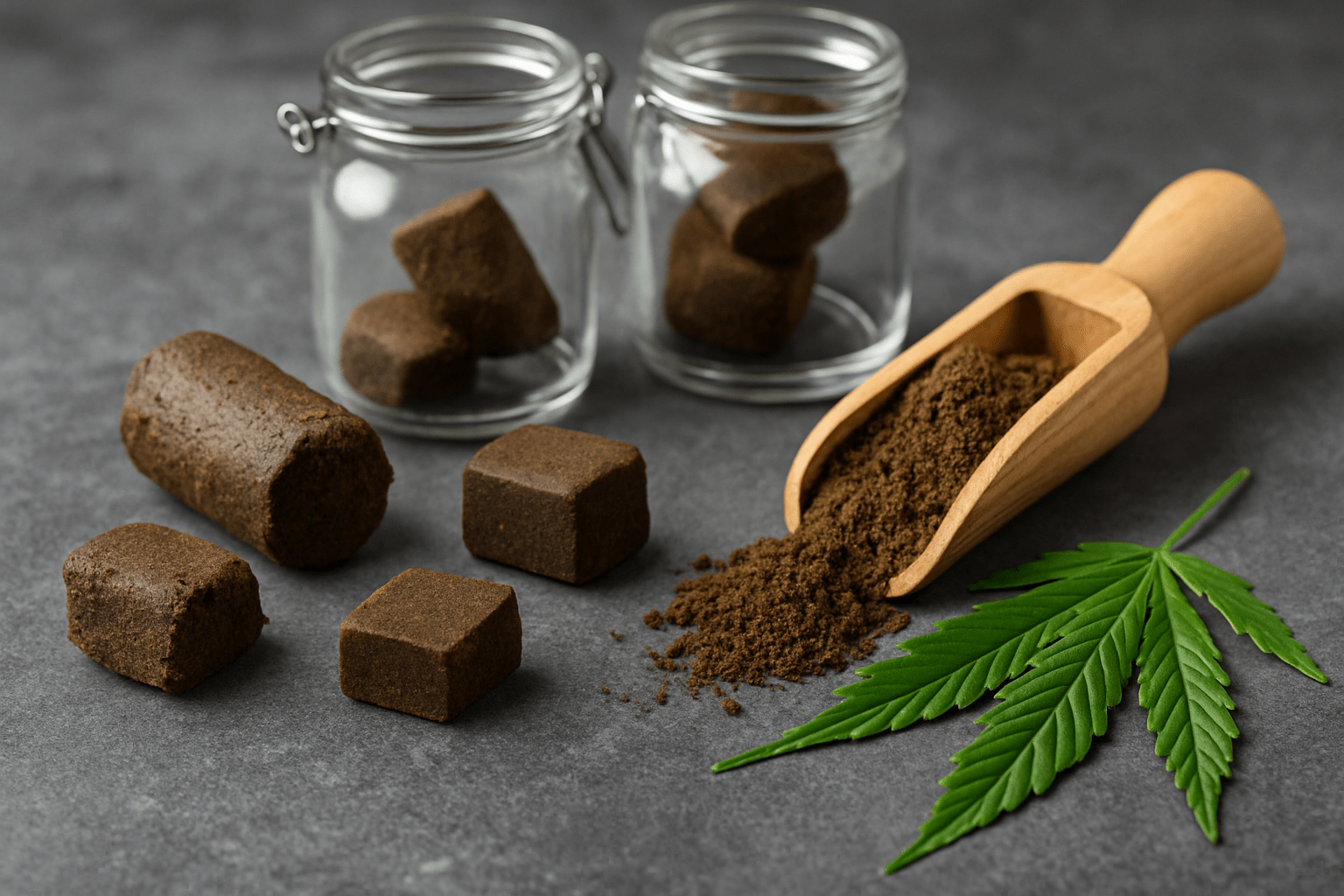
3D Printing: Hash CBD Pellet Mold
Introduction
3D printing has become an essential technology in many fields, from aerospace to regenerative medicine. Today, it is also entering the CBD sector, where precision and customization are crucial. In this context, the creation of Hash CBD pellet molds via 3D printing is gaining increasing attention. From technical design to legal and scientific challenges in Switzerland, every aspect must be meticulously managed to ensure a high-quality product that complies with legislation.
According to the Federal Office of Public Health (FOPH), cannabis is allowed in Switzerland if it contains less than 1% THC (see FOPH, “Low THC Cannabis” for general information). Beyond this limit, the product is considered a narcotic. CBD and Hash CBD producers must therefore ensure compliance with this standard to market their products legally. Additionally, the Narcotics Control Ordinance (OCStup, RS 812.121.1) imposes strict controls, especially when handling hemp extracts.
The purpose of this article is to present how 3D printing can contribute to the production of Hash CBD pellet molds while respecting the legal framework and quality standards. We will explore the key principles of 3D printing, the design of an appropriate mold, and usage precautions. We will also discuss trends around Hash CBD production in Switzerland, supported by studies and factual data.
1. Legal Context and Definitions in Switzerland
1.1 Legality of Hash CBD
In Switzerland, cannabis can be legally cultivated, processed, and sold as long as the THC content does not exceed 1%. Hash CBD is a derivative product of low-THC, high-cannabidiol (CBD) hemp. It appears as a compacted resin, often brownish or blackish, but can also take on lighter shades depending on the hemp varieties used.
- Article 2 paragraph 1 of the Narcotics Act (LStup, RS 812.121) establishes the classification of cannabis and its derivatives.
- The Narcotics Control Ordinance (OCStup, RS 812.121.1) specifies the conditions for market placement.
- According to FOPH guidelines, the THC level must remain below 1% for Hash CBD intended for sale (source: FOPH, section “Low THC Cannabis”).
1.2 Presumed Benefits of CBD
Although research on CBD effects continues to evolve, several peer-reviewed scientific studies explore its potential properties. According to a review published in the journal “Swiss Medical Weekly” in 2019 (1), CBD may have anxiolytic and anti-inflammatory potential without causing notable psychotropic effects. However, this data remains under validation, and it is essential to refer to updated studies to stay informed.
1.3 The “Do-It-Yourself” Trend
The growing popularity of CBD-based products fits into the “do-it-yourself” trend. Some consumers are increasingly interested in artisanal Hash CBD production, whether for economic reasons or the desire to control product quality and composition. In this context, the production of customized pellet molds via 3D printing meets a specific need: obtaining uniform, easy-to-transport, and dose pellets.
2. Basics of 3D Printing Applied to Hash CBD
2.1 How 3D Printing Works
3D printing, also known as additive manufacturing, involves creating an object by successively stacking layers of material. Different technologies exist:
- FDM (Fused Deposition Modeling): deposition of melted plastic filament.
- SLA (Stereolithography): photopolymerization of a liquid resin.
- SLS (Selective Laser Sintering): selective fusion of plastic or metal powder.
To manufacture a pellet mold, most enthusiasts turn to FDM, as it is more accessible and materials (such as PLA or ABS) are easy to obtain. A study published in the journal “Additive Manufacturing” (Volume 36, 2020) (2) indicates that the democratization of FDM printers and the wide range of available filaments make it an ideal choice for manufacturing small functional objects, such as molds.
2.2 Material Selection for the Mold
The material used to print a mold intended for food use or to press Hash CBD raises questions about safety and compliance with health standards.
- PLA (polylactic acid): biodegradable, with no known toxic substances when pure, but its heat resistance is limited. It may be suitable for occasional or low-temperature use.
- PETG (polyethylene terephthalate glycol-modified): more heat-resistant than PLA and considerably more durable, BPA-free (bisphenol A).
- ABS (acrylonitrile butadiene styrene): strong and durable, but emits potentially toxic fumes during printing and is not always considered safe for food contact.
For the specific use of CBD resin pressing, the temperature is generally not very high (many Hash CBD pressing processes are done at room temperature or slightly heated, rarely above 60 °C). The choice of PLA or PETG can therefore be justified if one ensures that the final product contains no residues from the printing process. It is also recommended to check the filament’s technical data sheet and perform post-processing (cleaning, fine sanding, possibly food-grade varnishing) to minimize contamination risks.
2.3 Precautions to Observe
According to Article 9 of the DFI Hygiene Ordinance (RS 817.024.1), any object intended to come into contact with food must be designed not to release any substances posing a health hazard. Although Hash CBD is not always considered food, it is a consumed product (and sometimes ingested in culinary preparations), hence the importance of observing certain precautions:
- Use certified filaments without dangerous additives.
- Avoid prolonged contact between the mold and solvents or chemicals.
- Regularly clean and sterilize the mold, ensuring it does not deform.
3. Designing Your Hash CBD Pellet Mold
3.1 Design Software
The first step in mold manufacturing is 3D design, which can be done with CAD (Computer-Aided Design) software such as:
- Tinkercad: a free, intuitive, and accessible platform for beginners.
- FreeCAD: more advanced open-source software suitable for technical projects.
- Autodesk’s Fusion 360: a professional solution free for personal use.
The key is to design a model suited to the desired shape and volume of Hash CBD pellets. Typical dimensions vary depending on the pressing method and the amount of resin.
3.2 Dimensions and Shape
Hash CBD pellets can vary in size, but a diameter of 1.5 to 2 cm for a thickness of 3 to 5 mm is common. Here are some elements to consider in mold design:
- A rounded shape allows for uniform compression.
- A low thickness (< 5 mm) facilitates pellet extraction.
- Slightly tapered walls (e.g., 2 to 3°) make demolding easier.
- Markers or logos can be included in relief to differentiate varieties or indicate origin.
3.3 Practical Steps for Design
- Define the pellet format: choose the desired diameter and thickness.
- Design the base and fit: the mold generally consists of two parts that fit together.
- Add vents: small air escape channels prevent bubble formation.
- Plan a locking system: pins or magnets help align the two parts.
- Finalize and export: check the solidity of your design, then export in STL (stereolithography) or another format suitable for 3D printing.
3.4 Printing Time and Post-Processing
Printing time varies according to:
- The size of the mold.
- The infill (for good solidity, an infill of 30 to 50% is common).
- The printer speed settings.
Once the mold is printed, cleaning is essential:
- Remove all supports and filament residues.
- Lightly sand the surfaces in contact with the CBD resin for a smooth finish.
- Optionally apply a varnish or food-grade coating (e.g., certified epoxy varnish).
4. Hash CBD Manufacturing Processes
To better understand how 3D printing integrates into Hash CBD production, it is useful to briefly recall common manufacturing methods.
4.1 Trichome Collection
Hash CBD is largely composed of trichomes, the resinous glands of hemp. Industrial hemp varieties authorized in Switzerland, with THC content below 1%, are generally used. Collection can be done via:
- Dry sieving: plant material is shaken over a fine sieve to separate trichomes.
- Ice water extraction: “bubble hash” uses several filter bags of different microns.
4.2 Drying and Pre-Pressing
After collection, trichomes are dried to prevent mold development. They can be light and powdery. A slight pre-pressing by hand or with a manual press then facilitates handling.
4.3 Pressing with the Mold
The 3D-printed mold comes into play to give the resin its final pellet shape. Here’s how to proceed:
- Prepare the resin with an ideal moisture content (previously dried).
- Place the desired amount of resin in the mold.
- Close the mold and apply sufficient pressure (manually or with a clamp).
- Let it rest for a few minutes, or slightly heat if the method requires it.
- Carefully open the mold and retrieve the Hash CBD pellet.
Using a uniformly designed mold results in pellets of consistent size and density. This facilitates dosing and packaging.
5. Storage and Packaging
5.1 Importance of Storage
Hash CBD is sensitive to humidity and light, which can degrade its compounds (cannabinoids, terpenes). To ensure product freshness and quality:
- Use airtight packaging, preferably vacuum-sealed.
- Store in a cool place away from direct light.
According to a publication in the journal “Frontiers in Pharmacology” (2018) (3), exposure to oxygen and light can lead to a progressive degradation of CBD and increase the relative rate of CBN (cannabinol). Thus, poor storage may decrease CBD content and alter the aromatic profile.
5.2 Suitable Packaging
For Hash CBD pellets, small individual sachets or airtight plastic or metal boxes may be suitable. Some professionals add a desiccant packet (silica gel) to control humidity. Always comply with mandatory labeling, including:
- Product name.
- CBD and THC content (with certificate of analysis if necessary).
- Required legal information (e.g., “CBD <1% THC”).
6. Limitations and Alternative Solutions
6.1 Health Safety and 3D Printing Limitations
Although 3D printing simplifies mold creation, health safety remains a concern. The micro-cracks and porosity inherent in some FDM prints can harbor bacteria. Molds must therefore be carefully cleaned and ideally coated with a food-grade varnish. PETG may prove more suitable than PLA or ABS, as it is less porous and more stable.
6.2 Alternatives to 3D Printing
For those who do not wish to venture into 3D printing, other options exist:
- Food-grade silicone molds: easy to find commercially, suitable for small batches.
- Stainless steel molds: high resistance, ideal for large quantities, but require significant initial investment.
- Specialized Hash presses: already available on the CBD market, with various formats and pressures.
7. Some Practical Tips
7.1 Regular Cleaning
After each use, rinse the mold with hot soapy water and dry it thoroughly. Use a cotton swab to reach any cavities, and ensure no resin residue remains.
7.2 Printer Maintenance
A poorly calibrated 3D printer can lead to dimensional inaccuracies. Ensure to:
- Check the bed leveling.
- Clean the nozzle after each printing session.
- Control the extrusion temperature and printing speed.
7.3 Hash CBD Quality Control
Beyond mere shape, Hash CBD quality must be laboratory-verified for THC content determination. Specialized companies offer precise analyses. According to Article 13 of OCStup (RS 812.121.1), companies are obliged to ensure compliance with the maximum THC level before marketing the product. Additionally, for consumers seeking more personal use, laboratory control is recommended if this Hash is intended for sale or if one simply wants to ensure quality.
8. Current Trends and Perspectives
Increasingly, CBD players are turning to personalization and self-production. Thus, 3D printing emerges as a key technology for innovating in mold creation:
- New shapes: triangular, hexagonal pellets, or adorned with inscriptions.
- Pressure optimization: some designers integrate mechanical or hydraulic pressing systems.
- Diversification: inclusion of additional terpenes or specific cannabinoids to create unique aromatic profiles.
Scientifically, research on Hash CBD focuses on:
- Extraction methods to preserve maximum terpenes (ongoing studies in private laboratories).
- CBD’s chemical stability and conversion into other cannabinoids during prolonged storage, a study addressed by “Frontiers in Pharmacology” (3).
Legislatively, Switzerland maintains a relatively liberal position on CBD compared to some neighboring countries. However, producers must comply with the THC level set at 1%, and reinforced controls are regularly conducted to prevent abuses.
Conclusion
3D printing offers great creative freedom and is a practical solution for making customized Hash CBD pellet molds. This process facilitates the standardization of pellet shape and weight, a major asset for a product that requires precise dosing. However, it is crucial to respect both legal aspects (THC level < 1%) and applicable health standards.
3D printing materials like PLA, PETG, or ABS each have specific characteristics that should be understood to ensure the mold’s safety and durability. Scientific studies and user feedback confirm CBD’s potential but also highlight the importance of extraction process quality and storage conditions to preserve the product’s properties.
Ultimately, using a 3D-printed mold for Hash CBD pellet production fits perfectly into the “do-it-yourself” trend and the quest for innovation within the CBD sector in Switzerland. With rigorous printer maintenance and strict product control, the result can be particularly satisfying: perfectly formed, homogeneous pellets that meet legal requirements. In the future, it is likely that new technologies and printing materials will further improve the quality and safety of these molds, allowing both amateurs and professionals to go further in customization and production efficiency.
(1) Borgwardt S. et al., “Cannabidiol reduces psychosis in patients with schizophrenia,” Swiss Medical Weekly, 2019.
(2) Smith D. et al., “FDM printing parameters for small-scale functional parts,” Additive Manufacturing, Volume 36, 2020.
(3) Citti C. et al., “Analysis of cannabinoids in commercial hemp seed oil and decarboxylation kinetics studies of cannabidiolic acid (CBDA),” Frontiers in Pharmacology, 2018.