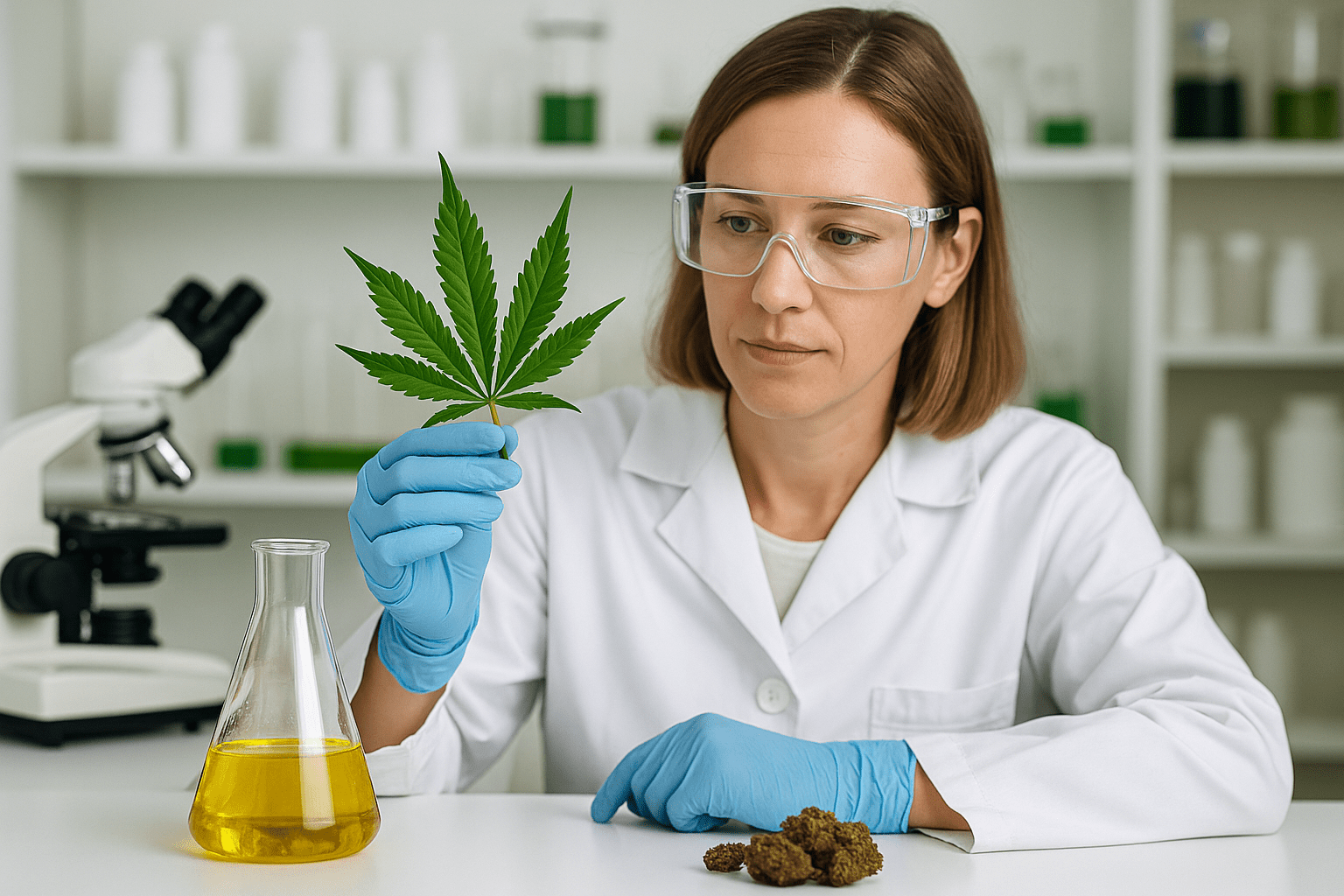
Isotopic Profile of THC: Differentiating Industrial Hemp and Recreational Cannabis
Introduction
The market for industrial hemp and legal cannabis has significantly developed in Switzerland in recent years. The increasing demand for CBD (cannabidiol) products is driven by consumers seeking alternative wellness solutions, relaxation, or simply a supplement to integrate into a daily routine. At the same time, Swiss authorities maintain a precise legal framework to distinguish industrial hemp, intended for the production of fibers, flowers, and CBD derivatives, from recreational cannabis whose THC (tetrahydrocannabinol) content exceeds the authorized limit. According to the Narcotics Act (LStup, RS 812.121) and the Ordinance on Cannabis for Medical Purposes (OCFMéd, RS 812.121.32), Switzerland allows the cultivation and commercialization of industrial hemp with a total THC content not exceeding 1%.
In the face of the emergence of hybrid varieties and extremely varied production methodologies (indoor, outdoor, greenhouse cultivation, etc.), the line between very low-THC hemp and recreational cannabis can sometimes seem blurred. To strengthen controls and prevent fraud, certain scientific analyses have emerged, including the study of the “isotopic profile” of THC. This isotopic profile is mainly based on the distribution of stable isotopes (often carbon and hydrogen) within the THC molecule itself.
In this article, we will explore in depth the concept of the isotopic profile of THC. We will see how it can help control authorities, as well as independent laboratories, to more easily distinguish industrial hemp compliant with Swiss legislation from recreational cannabis with psychotropic purposes. We will also discuss the importance of this method for the traceability and standardization of CBD products in the Swiss market.
What is the Isotopic Profile of THC?
The term “isotopic profile” refers to the distribution of different isotopes of a chemical element within the same molecule. Isotopes of an element have the same number of protons but a different number of neutrons, leading to very slight variations in mass. In the case of carbon, for example, isotope 12 (12C) is predominant, while isotope 13 (13C) is less abundant. For hydrogen, isotope 1 (1H) is mainly found, whereas isotope 2 (2H), or deuterium, is much rarer.
When specifically discussing THC, the analysis of the isotopic profile often involves measuring the 13C/12C ratio and, in some cases, the 2H/1H ratio. Differences in these ratios can arise from several factors:
- Growing conditions (light, humidity, temperature).
- Soil type and nutrient availability.
- Cultivation method (indoor or outdoor).
- The genotype and phenotype of the cannabis variety, whether industrial hemp or recreational cannabis.
The most commonly used analytical technique to determine the isotopic profile is isotope ratio mass spectrometry (IRMS). This method has long been used in fields such as geology or archaeology and has more recently extended to criminal and forensic analyses related to cannabis.
Scientific Reference: According to a study published in the Journal of Forensic Sciences (Kirleis & Pendergrass, 2017), the isotopic profiles of cannabis samples seized in different countries showed notable variations depending on the geographical origin and cultivation practices. This tool thus allowed tracing the source of cannabis production, clarifying whether it came from legal industrial cultivation or an illicit network.
From Industrial Cultivation to Recreational Cannabis: The Importance of Distinction
In Switzerland, the distinction between industrial hemp and recreational cannabis is not solely based on the proportion of THC, although this criterion is central. The legislation relies on the maximum legal threshold (1% total THC) to differentiate between an authorized product and an illicit one. That said, certain production techniques or genetic selection can lead to THC concentrations close to the legal limit.
For industrial hemp biotypes that usually comply with this threshold, isotopic analysis may initially seem superfluous since a simple THC content measurement will determine the legality of a batch. However, in borderline cases where THC content fluctuates between 0.7% and 1.2% due to biological variability, isotopic profile analysis offers complementary scientific data, particularly valuable in a context of:
- Criminal or customs investigations (to prove the origin and purpose of a cultivation).
- More thorough quality controls, when an independent laboratory wishes to certify the authenticity of the product for a producer or distributor.
How Does Isotopic Profile Analysis Work?
1. Sample Preparation
To measure the isotopic profile, laboratories start by taking a sample of dried plant material (usually flowers or leaf residues). The sample is then homogenized and reduced to powder. This preparation step is crucial to ensure the representativeness of the material on which the analysis is performed.
2. Extraction and Purification
Next, THC must be isolated from the plant matrix. Several methods exist, but the most common for laboratory analyses is to use organic solvents capable of selectively extracting cannabinoids. Once THC is extracted, additional purification steps (such as chromatography) may be necessary to ensure that other compounds (CBD, terpenes, flavonoids, etc.) do not interfere with the measurement.
3. Irradiation and Ionization
The purified THC is transformed into a gaseous form as it passes through an injector, then ionized. This allows the mass spectrometer to precisely measure the proportion of each isotope (mainly 13C and 12C). The mass spectrometers adapt the ions to a detector capable of differentiating their exact mass. The isotopic ratio is then calculated.
4. Calculation and Comparison
The isotopic ratios obtained (often noted as δ13C or δ2H in scientific literature) are compared to internationally recognized standards. Variations are generally expressed in parts per thousand (‰). By cross-referencing these data with a reference database (documented industrial hemp batches and seized recreational cannabis batches), the laboratory can deduce the probable origin of the sample.
Scientific Evidence at Stake
The principle based on isotopic profile analysis is not new. It is already used in criminology to trace the geographical origin of various illicit substances (cocaine, opiates, etc.). In the case of cannabis, its application is nevertheless more recent.
- Study by Kirleis & Pendergrass (2017) in the Journal of Forensic Sciences: This research indicates that the 13C/12C ratio varies significantly depending on whether the plant grew outdoors (with direct sunlight exposure) or indoors (with artificial lights). The study also suggests that cannabis plants grown in greenhouses exhibit an intermediate isotopic profile, reflecting a mix of natural and artificial influences.
- Swiss Research on Traceability: Analytical laboratories in Switzerland are increasingly working on local references. For example, they establish “baseline profiles” for different types of industrial hemp cultivation (Cannabis sativa L.), allowing for a fine comparison with samples suspected of being recreational cannabis.
These scientific proofs, accepted in judicial proceedings, enhance the reliability of official controls, particularly in distinguishing products whose appearance or THC content might cause confusion.
Swiss Legislation: Useful Reminders
To fully understand why differentiating between industrial hemp and recreational cannabis is important, it is necessary to recall some key points of Swiss legislation:
- Maximum THC Threshold: As mentioned earlier, the total THC content allowed in Switzerland for hemp is 1%. Swiss producers must ensure that their varieties and cultivation methods remain below this threshold (LStup, RS 812.121).
- Variety Catalogs: Some varieties are listed in official catalogs (often at the European level), listing certified hemp strains for industrial production. These varieties are known to produce less than 1% THC under standard cultivation conditions.
- Enhanced Controls: In case of doubt or anonymous denunciation, the police or the Federal Office of Public Health (OFSP) can order a complete analysis of crops or products (OCFMéd, RS 812.121.32). In these situations, isotopic profile analysis can become particularly interesting.
Advantages of Isotopic Profile Analysis for CBD Producers
After exploring the technical and legal aspects, one might wonder: how is the isotopic profile analysis of THC an advantage for Swiss CBD producers, rather than just a constraint?
- Transparency and Credibility: A producer wishing to guarantee the legality of their products (especially for export) can regularly conduct isotopic analyses. These reinforce their credibility with clients and authorities alike.
- Traceability: Traceability is a crucial component of the Swiss market, known for its quality demands. A certificate from an independent laboratory, detailing both cannabinoid content and isotopic profile, is a strong argument for B2B (business to business) sales.
- Fraud Prevention: In a competitive market, some companies might be tempted to import or market products with more THC than the authorized limit. Isotopic analysis makes fraud more difficult, as it establishes a “scientific passport” of the raw material’s source.
Limits and Application Challenges
Despite its relevance, the isotopic profile is not a miracle cure. Several challenges and limitations remain:
- Cost of Analysis: Implementing an IRMS (isotope ratio mass spectrometry) involves significant financial investment, and not all laboratory platforms are equipped with this advanced equipment. This can impact the final price of the analysis for the producer.
- Genetic Variability: Cannabis plants, even from the same variety, can show isotopic profile variations depending on phenotype, soil, or sunlight. Rigorous monitoring is necessary to accurately interpret results, especially to have a reliable comparison base.
- Need for Extensive Databases: To draw firm conclusions, a broad reference of analyzed samples is essential. Collaboration between Swiss and global laboratories is therefore crucial to refine the method’s precision.
Simplified Procedure for Inspections
Authorities, especially during a search or inspection, generally proceed in two steps:
- Initial THC Content Check: The officer or investigator can take a sample on-site and send it to a laboratory for THC measurement. If the level exceeds 1%, the product is considered recreational cannabis, and the goods can be seized. If the level is slightly above or very close to 1%, the investigation may continue.
- Isotopic Profile Analysis: If justified, the laboratory in charge of the expertise can perform an isotopic analysis to determine if the plant truly corresponds to reputed industrial hemp or if it comes from a recreational cannabis strain with high THC potential. In some legal cases, this additional proof can make a difference in case of dispute by the producer or distributor.
Focus on Sample Conservation and Transport
The reliability of isotopic analysis partly depends on the quality of sample conservation and transport:
- Temperature: Ideally, samples should not be exposed to significant temperature variations. Excessive heat can alter the chemical composition and influence the state of cannabinoids.
- Avoid Humidity and Light: A poorly stored sample, for example in direct sunlight or a very humid environment, risks cannabinoid degradation. This makes precise THC extraction more difficult and can potentially skew the isotopic ratio if the molecule begins to decompose.
- Hermetic Containers: Laboratories recommend sealing samples in opaque and airtight containers, accompanied by labels detailing the time and place of sampling, as well as the lot or producer’s identity.
Comparison with Other Analysis Methods
The isotopic profile of THC is a powerful tool, but it is often coupled with other approaches that provide complementary evidence:
- Genetic Analysis (PCR): Specific genetic markers for industrial or recreational hybrid strains can be studied. This method is useful for distinguishing authorized varieties (such as those listed in industrial hemp catalogs).
- Gas (GC) or Liquid Chromatography (HPLC): These analyses allow for precise measurement of cannabinoid content (THC, CBD, CBG, etc.). It’s the first step to verify compliance with legal limits.
- Infrared Spectroscopy (IR): Often used as a quick preliminary test, it can also help determine an overall plant profile, although it is less precise regarding exact dosage or THC origin.
In most cases, mass spectrometry and chromatography remain the reference methods for legal and official use.
Conclusion
The rapid development of the CBD market in Switzerland, along with increased quality controls and vigilant authorities, highlights the importance of scientific tools like the isotopic profile of THC. This approach, based on advanced IRMS technology, provides investigators, laboratories, and producers with a solid means to distinguish between perfectly legal industrial hemp and potentially non-compliant recreational cannabis.
Switzerland, with its tradition of precision and demand for traceability, is particularly well-positioned to leverage these investigative methods. Through collaboration among various stakeholders (farmers, laboratories, professional confederations, and regulatory authorities), the CBD sector can continue its expansion clearly and securely while maintaining consumer trust.
For producers, isotopic profile analysis is an additional asset to prove the compliance of their harvests. For authorities, it is an effective lever against fraud and the illicit resale of cannabis under the guise of industrial production.
Ultimately, the isotopic profile of THC is a welcome innovation in the Swiss regulatory landscape. It meets the growing need for more reliable and precise control methods for hemp and cannabis-based products. It is likely that its use will become even more widespread in the coming years, enhancing market transparency and consumer safety.