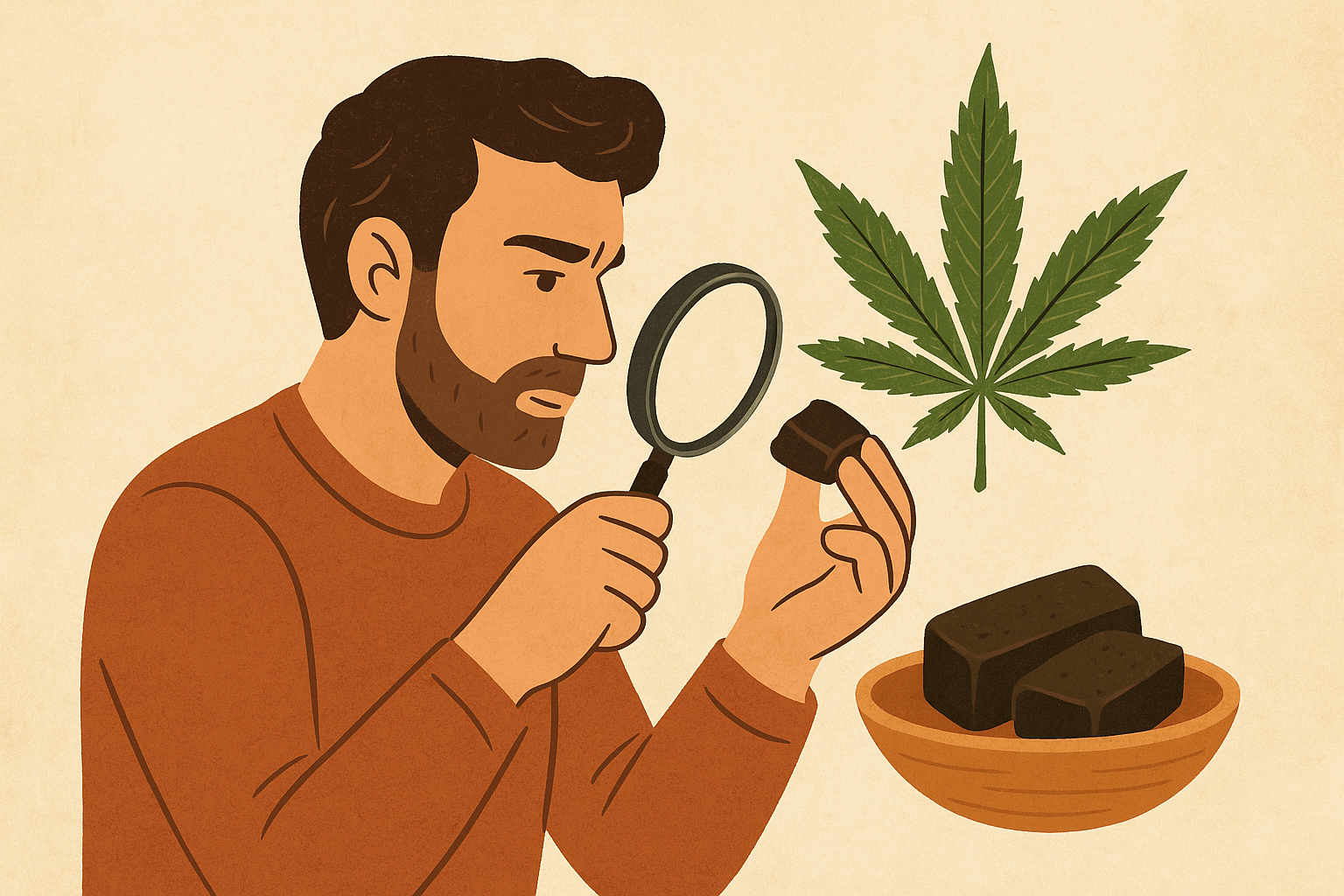
Micro-dosing CBD Hash over 30 Days: A Logbook
Introduction
Micro-dosing CBD Hash is gaining increasing interest in Switzerland. Long confined to more general uses, legal cannabis containing cannabidiol (CBD) raises questions about the best way to enjoy its potential effects without discomfort or excessive use. In this article, we offer a detailed 30-day logbook entirely dedicated to observing and analyzing the reactions that micro-dosing CBD Hash can generate. In Switzerland, legislation allows the sale of hemp and derivatives with a THC content not exceeding 1% (Ordinance on Narcotics Control, RS 812.121.1). This makes it possible to purchase legal CBD Hash, provided the product complies with legal limits.
A micro-dose is generally well below what is called the “standard” dose. This practice originated from the idea that small regular doses could provide certain benefits (stress management, slight muscle relief) without impairing alertness or causing marked side effects. Several peer-reviewed articles highlight that cannabidiol may have potential anxiolytic and anti-inflammatory effects (Crippa et al., Neuropsychopharmacology, 2011). However, these studies do not guarantee effects for everyone and do not constitute definitive medical recommendations. Therefore, we present here a simple feedback experience, supported by some legal principles and good practices in Switzerland.
What is Micro-dosing CBD Hash?
Micro-dosing involves consuming a smaller amount than the usual dose. In the case of CBD Hash, it can be as little as 2 to 10 milligrams of CBD per intake, ensuring that the THC content remains below 1%, in accordance with Swiss legislation (Narcotics Act, LStup, RS 812.121). The goal is to precisely manage the effects one wishes to observe, for example:
- Slight relaxation before bedtime.
- Support in managing stress or nervousness, a phenomenon still being studied by the scientific community (Zuardi et al., Journal of Psychopharmacology, 1993).
- Moderate muscle comfort, sometimes mentioned during physical exercises or sedentary jobs.
The micro-dose is not intended to “get high” or feel a notable psychoactive effect. Most often, it is a gradual approach to determine the optimal threshold, that is, the minimum effective dose for oneself.
Before Starting: Legality, Laboratory Analysis, and Precautions
Legal Framework in Switzerland
According to art. 2 of the Narcotics Act (RS 812.121) and the Ordinance on Narcotics Control (OCStup, RS 812.121.1), the sale of CBD Hash is authorized when the hemp-derived product contains less than 1% THC. Swiss authorities, through the Federal Office of Public Health (FOPH), ensure that information regarding THC content is clearly stated on products. It is also essential to verify its origins and laboratory certifications to comply with the ordinance.
Laboratory Analyses for CBD Hash
A CBD Hash producer must have their products analyzed by an accredited laboratory to confirm their cannabinoid content (CBD, THC, CBG, etc.) and the possible presence of contaminants (heavy metals, pesticides, mycotoxins). Legitimate laboratory reports allow verifying the exact CBD concentration and ensuring that THC levels remain below the legal threshold.
Usage Precautions
- Respect the dosages recommended by the manufacturer (or guidelines indicated on the label).
- Consider your health condition: anyone with a known pathology or undergoing medical treatment should consult a professional before experimenting with CBD Hash.
- Store CBD Hash in a cool place, away from light and moisture, to preserve the cannabinoid and terpene profile.
Methodology: How to Micro-dose Daily?
To set up a 30-day micro-dosing protocol, it is advisable to follow a few simple steps:
- Choose a reliable CBD Hash product.
- Verify the origin.
- Evaluate the exact CBD concentration through an analytical certificate (lab report).
- Define a starting dosage.
- For example, 5 mg of CBD per intake.
- Precisely adjust the amount of Hash (weight) to reach this dosage (calculation based on CBD content, usually provided as a percentage).
- Acquire a precision scale (to the hundredth of a gram).
- Weigh the CBD Hash in advance to avoid approximations.
- Maintain a routine (one intake in the morning, one in the evening, or according to your strategy).
- Keep a complete logbook.
- Note daily: date, time of consumption, dose, observations (emotional, physical, sleep quality, etc.).
Important: The micro-dose may vary between individuals. Some may feel better at 2 mg, others at 10 mg. The important thing is to start low, then adjust gradually.
30-Day Logbook: Experience Feedback
Below, we present a fictional logbook but constructed with serious observation in mind, considering current scientific principles. We will provide a weekly summary and a report of the main effects noted.
Day 1 to Day 7: The Discovery Phase
- Daily Dose: 5 mg of CBD (CBD Hash), consumed in two intakes (morning and evening).
- Consumption Mode: The person chose to vaporize the CBD Hash at a low temperature, as vaporization would, according to several independent laboratory reports, preserve the maximum cannabinoids and terpenes without combustion.
- Observations and Feelings:
- Days 1-2: Slight improvement in relaxation at the end of the day. No notable effects on concentration. No marked drowsiness.
- Day 3: The user notices better mood regularity. No sensation of euphoria or pronounced psychoactive effect.
- Days 4-5: Sleep seems more stable according to the user (more serene awakening, less muscle tension in the morning).
- Days 6-7: No notable change in stress levels, but a feeling of calm persists.
This first week is focused on getting bearings. The user takes care to measure the dose precisely using a small scale. The variations in feeling remain moderate, which corresponds to the very nature of micro-dosing: the goal is to perceive subtly rather than undergo a massive effect.
Day 8 to Day 14: Adjustments and Adaptation
- Daily Dose: 5 mg of CBD, still in two intakes, but the user decides to delay the evening intake by one hour to align it with their relaxation time (usually after work).
- Observations:
- Days 8-9: General feeling of slight well-being, with a slight decrease in daily nervousness.
- Day 10: Temporary increase in stress due to external factors (a heavier workload), making evaluation difficult. However, the user reports easier falling asleep despite the stressful day.
- Days 11-12: Continuity in sleep quality, less tension felt in the neck upon waking.
- Days 13-14: The user indicates a more stable emotional atmosphere. Relatives do not notice visible changes, which can be interpreted as proof of the absence of notable psychotropic effects but also as a sign of the organism’s gradual adaptation.
During this second week, the user experiences more stressful days and notices that, even if CBD Hash does not eliminate stress, it facilitates slightly easier nighttime recovery.
Day 15 to Day 21: Confirming the Rhythm
- Daily Dose: The user considers increasing to 6 mg in total (3 mg morning, 3 mg evening), based on the impression that the 5 mg dose is too low on some days.
- Observations:
- Days 15-17: The user slightly increases the dose, checks that tolerance remains good, and does not perceive a sudden change.
- Day 18: More relaxed day, feeling of slight improvement in well-being, without drowsiness.
- Days 19-20: Easier awakenings, as falling asleep the night before was quick. According to the logbook notes, the user feels less psychological fatigue.
- Day 21: Too early to conclude that micro-dosing is the sole cause of improvements, but the findings are encouraging.
Existing studies on low-dose CBD (Crippa et al., Neuropsychopharmacology, 2011) suggest potential anxiolytic effects, but interindividual variability is high. It is thus noted that the user feels more rested, without having significantly changed other aspects of their routine, except for this regular micro-dose.
Day 22 to Day 28: The Plateau
- Daily Dose: Maintained at 6 mg of CBD.
- Observations:
- Days 22-23: The user continues their usual schedule: work, light exercise (yoga or brisk walking), and a balanced diet. They report better muscle recovery, a phenomenon sometimes associated with the potential anti-inflammatory properties of CBD (Zuardi et al., Journal of Psychopharmacology, 1993).
- Days 24-25: Nights are deemed “restorative” according to annotations. The user notes falling asleep within 15 to 20 minutes, which is quite normal according to them.
- Day 26: Some concentration difficulties in the afternoon, unrelated to CBD Hash consumption, likely due to a lack of breaks. The user recovers quickly in the evening.
- Days 27-28: No notable change. A constant feeling of minimal but appreciable calm, without any sensation of “being in the clouds.”
The fourth week demonstrates a “plateau” effect: the organism seems to have found a certain balance. Of course, this does not replace medical support if one suffers from chronic pain or severe anxiety disorders.
Day 29 to Day 30: Final Assessment
- Daily Dose: 6 mg of CBD, taken in the morning and evening.
- Observations:
- Day 29: The user did not feel the need to increase the dose. The general impression of stability is maintained.
- Day 30: Conclusion on the experience: slight improvement in fluctuating anxiety, notable improvement in sleep quality and recovery. No dependency or marked side effects (limited dry mouth, no dizziness).
This 30-day self-experimentation, combined with compliance with the legal framework and examination of laboratory certificates, leads the user to consider micro-dosing CBD Hash as a potentially beneficial tool, without being miraculous.
Factors That May Influence the Experience
Individual Tolerance
Each organism reacts differently to CBD, as to any substance. Some metabolisms break down molecules more quickly. Others need more time to notice a change.
Consumption Mode
In this logbook, low-temperature vaporization was favored. Other modes, such as ingestion (capsules, edibles), can alter the absorption rate and sensations. According to several studies, the bioavailability of ingested CBD may be lower than by inhalation, due to digestive processes (Bruni et al., Molecules, 2018).
Product Quality
CBD Hash must be free of contaminants and come from hemp cultivation that complies with Swiss standards. A THC level above 1% would make it illegal. Independent laboratories play a key role here, certifying quality and composition.
Duration and Regularity
A one-time micro-dose over three or four days will not have the same impact as controlled consumption over several weeks. Consistency is often cited in studies concerning the action of CBD on the endocannabinoid system (Crippa et al., 2011).
Best Practices for Storing and Consuming CBD Hash
- Store away from light: UV rays can degrade CBD over time, leading to a decrease in actual concentration.
- Avoid humidity: Poorly controlled humidity can promote mold growth, degrading product quality.
- Use an airtight container: Maintain intact terpenes and cannabinoids.
- Respect temperature: A cool place (15-20 °C) preserves the freshness of CBD Hash longer.
To maximize quality, it is advisable to consult the producer or retailer and ensure that the production chain complies with current hygiene and safety standards.
Final Remarks on the Experience
- Absence of strong psychoactive effects: By staying below the 1% THC threshold, Swiss legislation classifies CBD Hash as a legal product, and the high associated with THC is not observed.
- Personal Feedback: Some users find in this micro-dosing a discreet support to improve their daily well-being.
- Not a substitute for medical treatment: CBD Hash, even in micro-dosing, does not replace medical advice. In cases of chronic pain or depression, it is strongly recommended to consult a healthcare professional.
Summary and Perspectives
At the end of these 30 days of micro-dosing, the typical user describes an overall feeling of calm and better recovery, without notable alteration of cognitive abilities during the day. The modest improvements are part of a global approach including a relatively healthy lifestyle.
To substantiate this finding:
- Micro-dosing CBD Hash could be considered by anyone wishing to experience a calming effect without exceeding legal THC limits.
- Laboratory tests remain essential to validate the quality of CBD Hash and rule out any contamination.
- The importance of regularity and precision in weighing cannot be underestimated, to avoid too significant fluctuations in the daily dose.
- Sensations are individual and can be influenced by lifestyle, external stress factors, and one’s own biology.
Further research is needed to expand the scientific understanding of cannabinoid micro-dosing. New clinical studies focused on larger samples would help support or invalidate certain hypotheses related to sleep, anxiety, or muscle recovery. In the current state of knowledge, it is permissible to say that there is no absolute consensus, but feedback and early scientific results invite further exploration of the potential of low-dose CBD Hash.
Conclusion
The 30-day micro-dosing of CBD Hash, documented in a detailed logbook, reveals a generally well-tolerated process, with subtle effects on relaxation and sleep quality. The slight improvements observed are accompanied by compliance with the Swiss legal framework (THC content < 1%) and laboratory examinations certifying product quality. The currently available scientific studies, although encouraging, highlight the variability of individual responses and the need for a personalized approach.
In conclusion, this 30-day experience highlights a micro-dosing practice that, without aiming for excess, could be an interesting avenue for some people seeking daily well-being. As always, it is important to combine caution and precise information, relying on reliable sources and rigorous laboratory analyses. Anyone wishing to undertake such an approach should ideally consult a healthcare professional to tailor the protocol to their situation.