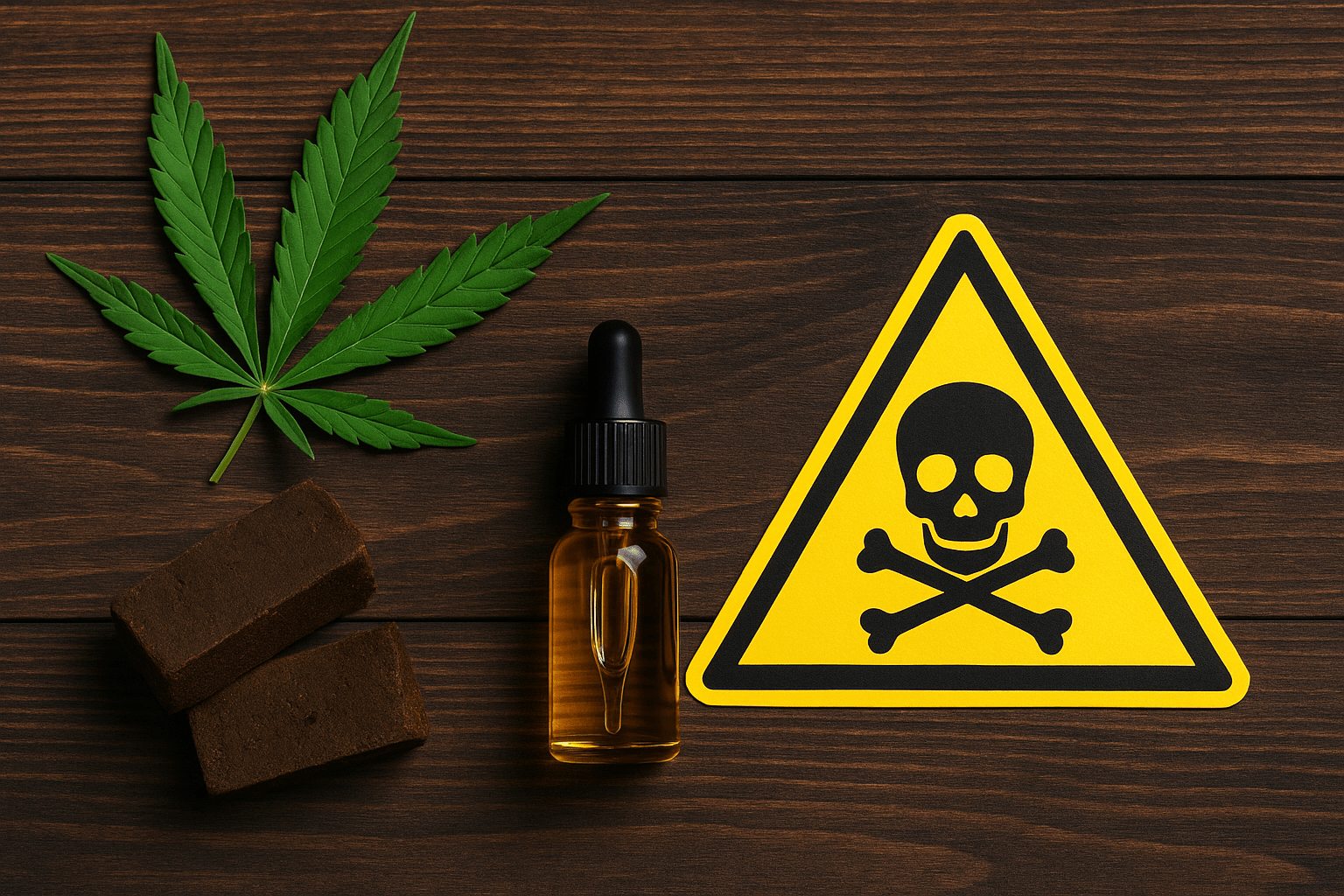
Residual Solvent Content: ICH Q3C Limits Applied to CBD Hash
Introduction
The production of CBD Hash often involves extraction processes using various solvents. Some of these, like ethanol or butane, may remain as traces in the final product. To protect consumer health, health authorities worldwide rely on precise guidelines to regulate these residual levels. One of the most recognized references is the ICH Q3C guideline (Impurities: Guideline for Residual Solvents), adopted and updated by the International Council for Harmonisation (ICH). In Switzerland, although this guideline is oriented towards the pharmaceutical industry, many CBD laboratories and producers rely on its recommendations to certify the quality of their products.
In this article, we will detail the principles and solvent categories defined by ICH Q3C, illustrate how these limits can be applied to CBD Hash production, and highlight the legislation and testing in force in Switzerland. All that follows is based on Swiss legal texts, peer-reviewed scientific studies, or recognized laboratory reports.
1. What is ICH Q3C?
1.1 History and Purpose of the Guideline
The International Council for Harmonisation (ICH) primarily aims to harmonize the technical and scientific requirements related to the registration of human-use medicines worldwide. The ICH Q3C guideline specifically addresses impurities in the form of residual solvents present in a finished product. These solvents may originate from various stages of chemical synthesis or extraction. The recommendations in this document guide industries on acceptable safety levels for human consumption [Source: ICH Q3C(R8), 2021, https://database.ich.org/sites/default/files/Q3C-R8_Guideline_Step4_2021_0513_1.pdf].
1.2 Application Areas
Originally, the ICH Q3C guideline targeted the pharmaceutical industry. However, it has become a reference standard for any product intended to be ingested or inhaled when consumer safety is at stake. In Switzerland, even though CBD products are not all categorized the same way as medicines, authorities and private laboratories often use these recommendations to verify product compliance [Source: Swissmedic, information on the application of ICH guidelines, available on the official Swissmedic website].
2. Solvent Categories Defined by ICH Q3C
The ICH Q3C guideline classifies solvents into three main categories based on their potential toxicity and danger to humans. These classes determine maximum exposure limits (PDE or Permitted Daily Exposure) and specific limits in finished products.
- Class 1: Solvents to avoid. They are recognized as carcinogenic or highly toxic, such as benzene. Their presence in a product is strictly prohibited or must be below the detection limit.
- Class 2: Solvents to limit. They can cause adverse effects with prolonged exposure or at high doses. For example, methanol is classified in category 2. Products containing these solvents must be analyzed to ensure they do not exceed imposed limits.
- Class 3: Solvents with low potential toxicity. These include ethanol or acetone. The limits are more generous because these solvents pose a lesser risk to human health.
This classification helps manufacturers and specialized laboratories prioritize corrective actions and control measures to ensure product safety.
3. CBD Hash Extraction Processes and Potential Residues
3.1 Different Solvents Used
In the production of CBD Hash, several extraction methods can be employed:
- Ethanol extraction (Class 3): This is considered a relatively safe process. However, if ethanol is not completely evaporated, the final product may contain traces.
- Butane extraction: Butane is a commonly used solvent as it is relatively effective for extracting cannabinoids. However, it is classified as a hydrocarbon. According to toxicity analyses, it requires strict residue control [Source: Eurofins laboratory report on cannabis extracts, 2021].
- Supercritical CO₂ extraction: Carbon dioxide is not considered a toxic solvent in the traditional sense, and it generally leaves no residue. It is one of the preferred methods for obtaining high-quality concentrates. However, it can be costly in terms of equipment investment.
The choice of solvent directly influences the nature and amount of residues in the final product. Manufacturers must therefore implement purification and laboratory control procedures to validate that the solvent content does not exceed imposed or recommended limits.
3.2 Laboratory Control Factors
Once CBD Hash is produced, laboratory analysis is most often performed using gas chromatography coupled with a flame ionization detector (GC-FID) or a mass spectrometer (GC-MS). These techniques allow the identification and quantification of residual solvents, even at concentrations in the ppm (parts per million) range [Source: GC-FID methodology, described in a study by the European Pharmacopoeia].
In practice, the laboratory checks compliance with the limits imposed by ICH Q3C. The results are then compared to the tolerance table for each solvent to determine if the product can be safely marketed.
4. Swiss Legislation and Guidelines
4.1 Legal Framework for CBD
In Switzerland, CBD is not considered a narcotic as long as its THC content is below 1% (Ordinance on the Control of Narcotics, OCStup, RS 812.121.21). However, the presence of solvents in a finished product intended for human consumption is governed by safety and quality principles described in the Ordinance on Foodstuffs and Utility Articles (ODAlOUs; RS 817.02). Even if these texts do not always specify mentions related to residual solvents in hemp-derived products, they impose a principle of consumer health protection.
[Source: RS 812.121.21, Ordinance on the Control of Narcotics & RS 817.02, Ordinance on Foodstuffs and Utility Articles]
4.2 Application of ICH Q3C Limits
The ICH Q3C thresholds are not explicitly anchored in Swiss law for CBD. However, practice has shown that many laboratories and producers refer to them to ensure quality. Swissmedic, which oversees the marketing of health products, also recommends using ICH standards to assess product safety in case of doubt. Thus, a CBD Hash manufacturer wishing to demonstrate compliance with international standards can mention adherence to the maximum values of the ICH Q3C guideline for the most critical solvents.
4.3 Laboratory Analyses and Certification
Several private laboratories in Switzerland offer residual solvent analyses for CBD-based products. Analysis reports generally mention:
- The solvents sought
- The detection threshold
- The measured concentration
- Compliance or non-compliance with applicable standards
CBD Hash producers can thus use these reports as a sales argument by proving that their products meet high standards of quality and safety.
5. Implications for Producers and Consumers
5.1 Importance of Quality Control
Controlling the residual solvent content in CBD Hash is not just a regulatory obligation. It is primarily a public health imperative. Residues of Class 2 solvents at high levels can cause long-term toxic effects. To meet these criteria, producers must:
- Choose extraction solvents that meet safety standards (ideally Class 3).
- Implement rigorous evaporation and purification processes.
- Regularly have their production batches analyzed by independent laboratories.
5.2 Consequences of Non-Compliance
If a product exceeds the recommended limits by ICH Q3C for one of the controlled solvents, it does not meet safety standards. In the Swiss market, it is generally up to the producer and distributor to manage the consequences. They may be required to:
- Withdraw the batch from sale.
- Inform customers and users.
- Review the manufacturing process to eliminate solvent excesses.
Even if legal sanctions will depend on the interpretation of current laws, non-compliance with thresholds can damage the reputation of the producer and retailer.
6. Practical Steps to Reduce Residual Solvent Content
6.1 Optimizing the Extraction Process
To reduce residual solvent content, CBD Hash producers can act at different stages of the process:
- Solvent choice: Prefer a Class 3 solvent (low toxicity) like ethanol, or use supercritical CO₂, which leaves no residue.
- Temperature and pressure: Using appropriate pressure and temperature parameters promotes optimal solvent evaporation.
- Professional equipment: An extraction setup with vacuum evaporation columns or efficient distillation systems allows better solvent removal.
6.2 Post-Extraction Purification
Even if extraction is well managed, residues may persist. The following purification techniques are useful:
- Fractional distillation: Separate each fraction according to its boiling point.
- Rotovapor (rotary evaporator): Reduce pressure and slightly heat to promote solvent evaporation.
- Vacuum drying: Eliminate minimal persistent traces by significantly lowering pressure.
When properly implemented, these techniques tend to bring residual solvent content well below ICH Q3C thresholds, ensuring product compliance.
6.3 Intermediate Analyses
Some quality-conscious facilities perform analyses at different production stages, rather than waiting for the finished product. This allows for quick identification if a batch is likely to be non-compliant at the end of the cycle. Intermediate controls may include:
- Measuring residual vapor pressure
- Rapid tests by gas chromatography
- Organoleptic control to detect solvent odors
This proactive approach significantly reduces the risk of having to destroy or withdraw an entire batch.
7. Focus on Consumer Health
7.1 Risks Related to Residual Solvents
The risks vary depending on the solvent class and the amount ingested or inhaled:
- Respiratory irritations: Vapors from solvents like butane or isopropanol can irritate the respiratory tract.
- Hepatic toxicity: At high doses, some solvents like methanol (Class 2) can affect the liver.
- Neurological effects: Chronic exposure to organic solvents can lead to nervous system disorders, although the amounts present in compliant CBD Hash are generally extremely low.
It is worth remembering that ICH Q3C thresholds are set to protect most individuals, including vulnerable people, based on multiple peer-reviewed toxicological studies [Source: ICH Q3C(R8), 2021].
7.2 Detection of Unusual Odors or Tastes
CBD Hash with a strong smell of alcohol or gas may indicate poorly eliminated solvent residue. For Swiss consumers, it is recommended to purchase products accompanied by an analysis report issued by a recognized laboratory. Several brands also indicate on their label “Laboratory Tested” or “Analyzed according to ICH Q3C standards” to build public trust.
8. Industrial vs. Artisanal Processing
In Switzerland, the CBD Hash market is constantly growing. Producers fall into two main categories: industrial companies and artisanal workshops. Each of these approaches has specificities regarding residual solvent management.
-
Large industrial facilities: They generally invest in professional equipment (vacuum extraction systems, chromatographs) and follow good manufacturing practices (GMP). Quality controls are formalized and rigorous.
-
Small artisanal workshops: Traditional know-how, sometimes passed down through generations, allows for authentic-tasting CBD Hash. However, if the workshop lacks optimal purification facilities, there may be a higher risk of residual solvents. Hence the importance for these artisans to subcontract analysis to an accredited laboratory.
9. Recommendations for Consumers and Professionals
9.1 Consumer Tips
- Check THC content: In Switzerland, a CBD product must contain less than 1% THC to be legal.
- Request a laboratory report: Ensure the manufacturer has analyzed their products for solvents, pesticides, and heavy metals.
- Read labels: A transparent producer will often indicate the extraction method and compliance with ICH Q3C or equivalent standards.
9.2 Best Practices for Producers
- Follow ICH Q3C classes: Avoid using Class 1 solvents and limit those of Class 2.
- Train in GMP (Good Manufacturing Practices): GMP helps structure the entire production chain, from raw material supply to the finished product.
- Maintain dialogue with laboratories: To optimize analyses and ensure result reliability, transparent communication with the laboratory is essential.
10. Recent Studies and New Directions
10.1 Update of the ICH Q3C Guideline
The most recent version of the ICH Q3C guideline is version R8 (Revision 8), adopted in 2021 [Source: ICH Q3C(R8), 2021]. It has reinforced certain limits for newly evaluated solvents. It is based on updated toxicological studies that specify safety thresholds for use in the pharmaceutical industry. Although the developments mainly concern the pharmaceutical sector, they are also of interest to medical cannabis manufacturers and, by analogy, CBD Hash producers wishing to comply with the highest standards.
10.2 Regulatory Developments in Switzerland
The CBD sector is expanding and receiving increasing attention from authorities. Discussions around the controlled legalization of cannabis for recreational purposes could gradually include regulatory updates on the quality and purity of CBD products. New ordinances or circulars could incorporate target values for residual solvents, thus providing a more precise legal framework. In this regard, Swissmedic and the Federal Office of Public Health (FOPH) remain reliable sources for any regulatory developments.
Conclusion
The issue of residual solvent content in CBD Hash, although still not detailed in Swiss legislation, is crucial for public health and consumer trust. The ICH Q3C guideline provides a universally recognized framework for assessing risks related to residual solvents. In the absence of specific CBD regulations, many laboratories and producers in Switzerland have voluntarily adopted these standards. The three solvent classes established by ICH Q3C guide the choices of extraction and purification processes to ensure the safety of the finished product.
For producers, it is an opportunity to stand out with a strong quality commitment. For consumers, it is a sign of seriousness and trust, supported by independent laboratory analyses. Although Swiss authorities do not formally impose compliance with the ICH Q3C guideline for CBD Hash, they encourage responsible practices. Upcoming regulatory developments could further strengthen monitoring and standardization in this growing segment.
In summary, adhering to the solvent limits defined by ICH Q3C is a logical choice for any company concerned with offering high-quality, safe CBD Hash. It is a step towards professionalizing the sector, where transparency and consumer well-being are at the forefront.